Egyptian Gods
Ancient Egyptian Gods and Goddesses


Tree Goddesses
 |
| A tree goddess, symbolized by her fruit-tree headdress, bestows offerings on the deceased. 18th Dynasty. Tomb of Nakht. Western Thebes. |
Several Egyptian gods were associated with trees: Horus with the acacia, Osiris with the willow, Ra with the sycamore and Wepwawet with the tamarisk, for example; but none of these male Egyptian gods held ... This page has moved to: Tree Goddess page on Egyptian God's new website.

Tjenenyet
Tjenenyet is first attested by name on carved blocks dated to the 12th Dynasty but may have existed prior to that time. She was worshipped, along with the goddess Iunit, as joint consort of the falcon deity Montu in the town of Armant (Hermonthis) and in the surrounding Theban region. In the Ramesside Period of the New Kingdom she rose to somewhat greater importance, but declined in later ancient Egyptian history. Although sometimes thought to be the same as the goddess Raet, the association does not seem likely as the two Egyptian gods are known to have been depicted together.
Tayet
Tasenetnofret
A goddess with only fairly localized importance, Tasenetnofret was honored at Kom Ombo in Upper Egypt as the consort of Horus and mother of Panebtway. Her name means 'the good sister' or 'the beautiful sister' and she appears to be essentially a local manifestation of Hathor.
Sothis
 |
| The combined Isis-Sothis standing in the barque in which she crossed the heavens. Roman Period. |
Mythology of Sothis
The goddess who personified the bright, first magnitude star Sirius (the 'dog star') was called Sopdet by the ancient Egyptians and Sothis by the Greeks. Her husband was Sah, god of the neighboring constellation Orion, and her son Soped or Sopdu, another astral deity. The importance of Sirius for the ancient Egyptians lay in the fact that the star's annual appearance on the eastern horizon at dawn heralded the approximate beginning of the Nile's annual inundation which marked the beginning of the agricultural year. Thus the goddess was called 'bringer of the New Year and the Nile flood' and became associated at an early date with Osiris who symbolized this annual resurgence of the Nile and who was also personified in the night sky by the neighboring constellation Orion. Even as early as the Pyramid Texts Sothis was described as having united with the king/Osiris to give birth to the morning star, Venus, and through her association with the netherworld god she was naturally identified with Isis - eventually appearing at times as the combined goddess Isis-Sothis.
Iconography of Sothis
 |
| The goddess Sothis with her characteristic crown surmounted by a five-pointed star. Late Period bronze statuette. British Museum. |
Worship of Sothis
The star Sirius may have been worshipped as a cow-goddess in predynastic times, but eventually became identified with Isis and with Sothis. While Sothis was clearly a goddess of some importance in her own right, her increasing identification with Isis led to a lessening of her individual identity in later times. In the Old Kingdom she was important as a deity of the inundation and as an afterlife guide to the deceased king, yet by the Middle Kingdom she is identified as a 'mother' and 'nurse', and during the Graeco-Roman Period her assimilation with Isis was almost complete.
Seshat
 |
| The goddess Seshat, wearing her enigmatic emblem on her head and a stylized scribal palette on her shoulder, writes upon the notched palm leaf rib which denoted the word for 'year' in the hieroglyphic script and which was symbolic of recorded time. The goddess was said to inscribe the length of the kings' reigns in this manner at their accession. 19th Dynasty. Luxor Temple. |
Female Anthropomorphic Egyptian Goddess
Mythology of Seshat
Seshat (literally, 'the female scribe') was the goddess of all forms of writing and notation, including record keeping, accounting, and census taking as well as being 'she who is foremost in the house of books': the patroness of temple libraries and other collections of texts. The goddess is known from as early as the 2nd Dynasty when she is attested assisting King Khasekhemwy in the ritual 'stretching the cord' ceremony, as Seshat was also the 'mistress of builders' and it was she who established the ground plan on the founding or expansion of every sacred structure. Beginning in the Old Kingdom Seshat is also found recording herds of different types of animals seized as booty, and from the Middle Kingdom she records the names of foreign captives in addition to their tribute, and in New Kingdom temple scenes she records the king's regnal years and jubilees on the leaves of the sacred ished or persea tree. Along with Nephthys, Seshat was said to restore the members of the deceased in the afterlife. The goddess was also associated with some few other Egyptian gods, mainly the god Thoth whose sister, consort or daughter she was variously said to be. In New Kingdom times Seshat was parallelled by the goddess Sefkhet-abwy whose characteristics and attributes seem to be virtually identical to her own. It is unlikely, therefore, that she is really anything but a form of Seshat.
Iconography of Seshat
Seshat was depicted in anthropomorphic form as a woman often wearing a leopard skin over her robe and with a headdress consisting of a headband with a tall extension upon which was an obscure emblem resembling a rosette-pointed star. This 'star' is often surmounted by a bow or crescent moon-like symbol resembling downturned horns, which was itself sometimes crowned by two falcon feathers. Usually the goddess holds a palm rib upon which the years were notched and which may terminate in a tadpole (the hieroglyphic number for 100,000) seated upon the shen (eternity) hieroglyph symbolizing an infinite number of years. In scenes where Seshat records the jubilees of the king, hieroglyphic signs for the festival are also suspended from the tip of the branch. When she is depicted alongside the king in the foundation ceremony, Seshat often holds the stake and mallet and stretches taut the line used to mark out the parameters of new buildings.
Worship of Seshat
By her very nature Seshat was a deity of official building, recording and writing projects and she rarely appears to have had no temple of her own, but by virtue of her role in the foundation ceremony she was a part of every temple building. In a similar manner she played no real part in popular religion, although she may have been held to be a patron goddess of sorts among scribes and builders.
Satis
 |
| Silver amuletic statuette of Satis. Third Intermediate Period, 21st-24th Dynasty. Harer Collection. San Bernardino. |
Mythology of Satis
The Upper Egyptian goddess Satis guarded the southern frontiers of ancient Egypt and in historical ties and was also connected with the Nile. Her link with the upper reaches of the Nile perhaps caused her to be associated with the annual inundation and with Elephantine in the area of Aswan which ancient Egyptian mythology sometimes identified as the source of the Nile. Her name is first attested on stone jars found beneath the Step Pyramid at Saqqara (3rd Dynasty), and by the 6th Dynasty she is mentioned in the Pyramid Texts as purifying the deceased king with four jars of water from Elephantine. As 'mistress of Elephantine' Satis became the consort of Khnum and thus mother of Anukis, though a relatively early connection with the Theban god Montu is also known for Satis and the original consort of Khnum appears to have been the goddess Heket. When Khnum was identified with Ra, Satis became an 'Eye of Ra' and the goddess then sometimes assumed some of the characteristics of Hathor, the goddess more usually depicted in this mythological role. Satis was identified with the star Sirius, called Sothis, which heralded the Nile inundation each year. The Greeks identified Satis with Hera, the wife of Zeus.
 |
| Satis (at right) embraces Tuthmosis III. 18th Dynasty. Carved block, temple of Satis, Elephantine. |
Iconography of Satis
Satis is almost always depicted as a woman wearing the conical White Crown of Upper Egypt to which are attached antelope horns or plumes and a uraeus. Usually she wears a simple sheath dress and may carry an ankh or was scepter as signs of her divinity rather than personal attributes. Early writings of her name use a hieroglyph representing a shoulder knot in a linen garment, but later writings use an animal skin pierced by an arrow. This latter symbol could have been assimilated from Anukis the huntress goddess who came to be seen as her daughter. The symbol is sometimes depicted with the goddess in representational works.
Worship of Satis
The principal cult center of Satis was at Elephantine where her shrine was built on an early predynastic site. Research by Ronald Wells has shown that elements of the temple of Satis were carefully aligned with the position of the star Sothis or Sirius in the night sky, trying the goddess in this manner to the star's rising and the annual inundation of the Nile. It has also been pointed out that the goddess's temple was situated at a point where the waters of the inundation might be heard before they became visible in the lower reaches of the Nile, so that her function of protector of the borders could also be tied to that of guardian of the Nile's flood and its resultant fertility.
Renpet
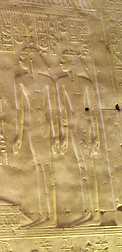 |
| Renpet (right) and Maat |
Renpet is a minor goddess who personified the year, and was recognized by the notched palm branch which was the hieroglyphic sign for 'year' which she wore on her head. Renpet was quite frequently depicted in temple and other scenes but had no important cult.
Raet
Female Anthropomorphic Egyptian Gods: Raet
By at least the 5th Dynasty a female counterpart had been assigned to Ra, the sun god, and the simple name of the goddess - the feminine form of the name Ra - indicates that she was created to complement the sun god rather than having been a deity with an independent prior existence. In the Pyramid Texts the goddess is called Raet and and though a fuller variant of her name was Raettawy, 'Raet of the Two Lands', it is uncertain at what point this form was first used. In later times she was addressed by the expanded titles 'Raet of the Two Lands, the lady of heaven, mistress of the Egyptian gods', parellel to the superlative titles of her husband. Nevertheless, the goddess played a lesser role in ancient Egyptian mythology than Hathor who was also viewed as the wife or daughter of Ra. Raet is therefore not frequently represented pictorially and is usually depicted in a Hathor-like form as a woman wearing a solar disk with horns and a uraeus, sometimes with the addition of two feathers above the disk. A festival of Raet was held in the fourth month of the harvest season, and she was venerated, along with Montu and Harpokrates, in the Graeco-Roman temple of Medamud.
Qadesh
 |
| Upper section of the stela of the royal craftsman Qeh from Deir el-Medina showing the goddess Qadesh flanked by her consort, the Asiatic god Reshep (right), and the Egyptian fertility god Min (left) who was associated with the eastern desert regions. 19th Dynasty. British Museum. |
Female Anthropomorphic Egyptian Gods: Syrian Goddesses
Mythology of Qadesh
Qadesh was a Syrian goddess of sacred ecstasy and sexual pleasure. Her Semitic name would seem to mean 'holy' and despite her Near Eastern origins, the goddess was thoroughly assimilated into ancient Egyptian religion in New Kingdom times to the extent that she was worshipped as part of a popular divine triad along with the fertility god Min and the Asiatic god Reshep. Qadesh was often linked with Hathor whom she resembled in some ways and with the inherently sensual Near Eastern goddesses Anat and Astarte, both of whom were known in ancient Egypt.Iconography of Qadesh
In ancient Egyptian representations Qadesh
Nehemtawy
Female Anthropomorphic Egyptian Gods
A minor goddess known mainly as the consort of the serpent deity Nehebu-Kau or of Thoth. Nehemtawy usually appears in anthropomorphic form and was frequently depicted in the shape of a goddess nursing an infant on her lap. In representations of this type she can usually only be distinguished from other nursing goddesses such as Isis and Mut by her headdress which is usually in the form of a sistrum. Little is known of the worship of the goddess other than that she was venerated with Thoth in his cult centers, especially that of Hermopolis in Middle Egypt.
Subscribe to:
Posts (Atom)